22 August 2015

Family History Documentation at your Fingertips Series, Part 1


Family Heirlooms
Family Picture Box

Family history can be found in the home of a recently deceased relative.  The chore of going through old papers and pictures seems overwhelming. Often the items are placed in a box and not stored correctly, or worse, thrown away.

Photos

When someone passes away in our family, we will inquire about any pictures, scrapbooks, and papers, so that we can review the material. By doing so, I was recently given an old box made by my grandfather Jack Goolsby, to keep for the family. To our delight, we found a wedding picture of my great grandmother Lula Goolsby Ison and her first husband, William Edward Goolsby.  My dad had never seen his grandfather before because he was deceased when my Dad was born.  His grandmother and his grandfather were divorced, so old pictures were not readily available.  His grandmother had also remarried.  A side note to this is my husband spent hours enhancing a digital image of the picture to make  the back of the picture to make it readable.  The wedding picture had been used by an artist to make a painting of the couple and a detailed description of their names and clothing colors were on the back.  The picture was in black and white.  What a find!  Some of the techniques to use to make a picture is (list techniques)

Memorial Book

The other huge find for us was the death book for my grandfather Jack Goolsby.  Family oral history stated that he was born in Eccles, WV.  We were unable to locate a birth record for him in WV delayed or otherwise. We didn't review this heirloom right away but decided to shuffle through albums and scrapbooks.   When we did sit down and review the Death Record, we found a page completed by his mother, my great grandmother Lula Goolsby Ison, that documented his birth in Clifton Forge, VA.  This made sense because his father William Goolsby worked on the railroad in Clifton Forge Virginia and he and his wife, Lula were married there.


Guest Books

Warner Camp Guest Book
David's mom's family, Warner, has a camp, on Lake Messalonskee in Maine.  The camp is an old house built in the early 1900's.  Two story home with a guest house, boat house, and garage.  The family would open the camp in the summer and close it before winter.  There were multiple pictures in the home that we carefully digitized and the best record?  The family had kept a guest book of all that had visited the camp throughout many of the years.  The visitors would list the date, their name, the name of their children and sometimes, the ages.   Not only did this document the history of Warner Camp, it is also documentation on the relationship of the family members and can help narrow down lifespans.


Bibles

Family bibles are a haven of information.  Before official governmental records were kept and even after, many families recorded births, deaths, and marriages in the family bible.  Frequently, bibles are passed down from generation to generation.  Recently, while we were discarding material at the dump, a man emptying his truck found a bible someone had discarded.  He felt funny about not rescuing the book.  Upon examination, it had completed pages of marriages, deaths, and births.  We decided that even though the information wasn't pertinent to either of our families, that the pages should be carefully digitized and made searchable on the internet.  In a few years, this might be the document that helps a family push through their own roadblock.


If you have found family historical information in other places please email or comment.  Sometimes it is a small piece of information that opens the door for family historians, and knowing where to look is helpful.


Samuel Carter Cemetery - Part II

Combing Through The Trees

We were so relieved to actually find a cemetery after hiking what seemed like miles up the hill, we didn't even worry that it looked like only a few grave sites. The small clearing was very pretty anyway, and we could declare a victory. So we set out to photograph the stones.

Copyright 2014 Slowmoto Graphics
As we got up into the clearing more, we saw some huge stone pillars back in the trees. They looked like part of a gateway almost. A little surreal, like a scene from The Lion, The Witch and The Wardrobe. (Or at least the way I pictured the scenes reading the book as a child)  Joseph related the larger monuments to chess pieces, a bishop and a rook.

We started towards the pillars, and noticed a few more grave stones on the way. Samuel scrambled around between the pillars and found the inscriptions, which of course proved them to be massive monuments.

When we got through those stones, we found marker after marker stretching back into the woods. The trees and bushes had grown up so much, it was a jungle. There were tree branches down, massive grape vines, brier bushes, and whole trees down. It was a riot of vegetation, old and new.

It felt like a Harrison Ford movie. Sherry might change our blog name to "Indiana Stones" or something after this experience. What fun it was!
Copyright 2014 Slowmoto Graphics

We ended up finding about 30 some grave markers. More than that, really, as some were face down, or covered with fallen trees too big to shift. But amazingly most of the ones we could actually see the front of were legible.

There was a little fenced-in section you can see here. I think this one had the Coleman monument.

There was a section with Samuel Carter's grave. He has two markers - an earlier one and one he shares with his wife.

We also found two markers for Nannie Wood, one with her husband Caleb. We found Nutters, Skaggs, Mosleys, lots of Carters and Eatons, Colemans, Beckelhimers, an Akers, an Adkinson, a Tincher and an Amick.

We knew there were going to be some interesting stories when we started researching these people. But little did we know how much we would find.

Continued soon...

19 August 2015

Wisdom Wednesday - Always Look At The Source

Always look at the source record if you can.

Ancestry.com and presumably other sites let you easily pull in data from census records, birth certificates, and so on.  But be careful, if you don't look at the source records yourself, you may be missing valuable information.

Transcription Errors

The transcriptionists have done an amazing job. There are a lot of entries I can't even begin to make out, but I look at how it was transcribed and then I can see that it looks accurate. But everyone makes mistakes, and once in a while a name like Susan gets transcribed as Suean and if you don't look at the actual record, suddenly you've got some kind of weird Irish name in your family where it doesn't belong.

You don't have to be fanatical about this - just take a glance at it so that when you merge the transcribed data you have some idea of what it should be already and can spot obvious problems before they make it into your tree.

Not all data is pulled in automatically

Some Census data does not make it into your tree - key items like Occupation as well as did they own or rent the home, live on a farm, read and write and so on. Some of the data isn't transcribed, and other data just doesn't have a place for Ancestry to put it.

Looking at the data gives you a better sense of your ancestors, and helps you figure out if the record is actually for someone in your tree or not.  For instance, if your great grandfather who was a carpenter all his life is listed as a coal miner on one record, you can look twice at that one to make sure it is really your GGF.

Early Records

Before 1860, Census records don't include the relationship to the head-of-household field. Since the field isn't there in the record, Ancestry can't assume that people in the same household are the same family, so it doesn't bring them other records in when you merge the single one you found in your search.

All it takes is to look at the data, make a note of the other people in the household, and make sure you get those records added for them as well.

Neighbors

When you pull up the record, look at who the neighbors are. The simplest way is just look at the households before and after the one you've found. Keep an eye out for names that show up later in your history.

If you get stuck finding a census record for a particular year, but you know who the neighbors are, you can search on the neighbors in the missing year. Maybe you'll get lucky and find the record for Uncle Joe that got entered as Moe and didn't come up in your search.

Non-Census Records

Ancestry seems to be optimized for Census records, and that's where most people start. And that's fine. My point here is - when you pull up non-census records, be even more careful to examine the records visually because often most of the information will not be pulled in.

Is it significant that the pastor that married Uncle Joe has the same last name as his spouse?  You'll never know if you don't look at the record. 

Draft cards are very interesting - they usually list another contact person (wife or mother or father usually) and give details like height, eye and hair color.

Feedback

If this post helps you, and you find some tidbit you might have missed if you hadn't looked at the source, we would love to hear from you - leave a comment below.

16 August 2015

The Search for John Yeoman McKenney

Distortion of facts plagues a genealogist when recovering history to track down a missing ancestor.  Family stories passed down from one generation to the next coax us to research in a certain state or country. However, if the information isn't accurate it can derail progress in uncovering your ancestors.

Recently, we were able to sift through jumbled information to find my great great great grandfather.  The information given to us from a very knowledgeable cousin was correct, but instead of belonging to just one ancestor, the information was a mix of facts from several ancestors.   Assigning all these facts to a single ancestor threw up a brick wall.

Several years ago, my cousin sought out my father to compare family notes and heritage, and he left my father pictures of our shared family branch.  When I began researching our family history, my father gave me the pictures.  I was very excited and called my cousin for more information. We learned from him that John Y. McKenney was my great great great grandfather and the grandfather of Lucy Ellen McKenney, my great grandmother. 

My husband and I interviewed my cousin. He too is descended from John Yorman McKenney and he wanted information on John's father.  The information he did have was:

  • John Yorman McKenney
  • Born 10 Nov 1800 in Donegal, County Claire, Ireland
  • Educated as a priest at Oxford and studied medicine.
  • Arrived in New York from Northern Ireland In 1830s, after breaking with the Catholic Church, he left "quickly" to avoid persecution.
  • Traveled to Indiana, tending to the sick,  then to Virginia.
  • Married Lucy Dew in Virginia.
  • Teacher in Covington, VA
  • Died in 1862
  • Buried beside his wife, Lucy, at The Old Greenbrier Church, Alderson, WV, in unmarked graves.  
  • Judson Mckenney, his son, is buried there in a marked grave.
This information needed to be verified with a final goal of finding his parents, and continuing to unravel our family tree. One of the first records we located was a survey completed by Bess L. Blanche in 1938, titled “Survey Report, John Y. McKinney home site”, http://image.lva.virginia.gov/VHI/html/01/0023.htm.

From this report we extracted the following information:
  • John Y McKinney, County Claire, Dunegal, Ireland
  • Graduate of Oxford University, studying to be a priest and medicine
  • Broke with Catholic Church
  • Traveled to New York
  • Settled in Indiana and Virginia
  • Married Lucy Dew, daughter of William Dew
  • Lived in a home on the land of William Dew
  • Worked as an educator
  • Son by the name of Galvana
The report cites Mrs J P Sullender (my great aunt)  and the Allegheny Court Records as sources. Mrs. J P Sullender was the granddaughter of John Y. McKenney.  The information matched what my cousin had said almost exactly.
However, we still wanted to obtain records that would validate the history and possibly list John Y McKenney's parents.
David and I traveled to Ireland and visited genealogy centers. The genealogy center in Galway, Ireland, was unable to locate records for John McKenney. We didn't find a birth record.  Oxford University’s list of alumni from that time period didn’t list John McKenney as a graduate or a student  We didn't find a definitive immigration record. We didn’t find him listed as a Catholic priest in Ireland.  We didn’t find information in historical books from that time period.  We didn't find a death record. 
The records we did locate were: 
Marriage certificate:  John G. Mckenney married Lucy Dew on 14 June 1838 in Virginia.
"Virginia, Marriages, 1785-1940," index, FamilySearch (https://familysearch.org/pal:/MM9.1.1/XRC2-52C : accessed 28 Sep 2014), John G Mckenney and Lucy Dew, 14 Jun 1838; citing Alleghany, Virginia, reference P. 8, No. 201; FHL microfilm 30523. 

1840 United States Census, John G McKenney, Botetourt, VA.  An adult female is listed but the 1840 census did not list family members by name.  

1850 United States Census, John Y. McKinny, 50 years old, born in NY, wife Lucy, two children listed.  He was a teacher.

1860 United States Census, John G. McKenney, 54 years old, born in New York, wife Lucy, with six children, including Judson as a twin of James, and my great great grandfather Galvani McKinny, Mary, Ellen, and Stuart. He was a teacher.

1870 United States Census, Lucy Mckenney and his children were listed without John Y Mckenney, which should indicate he was deceased or not living with his family.

David and I traveled to the cemetery reported to be the final resting place of John Y. McKenney, his wife Lucy, and his son, Judson.   We located the memorial for his son, Judson P. McKenny born 24 Mar 1852 died 4 June 1888 in the Old Greenbrier Baptist Church Cemetery in Alderson, West Virginia. The oral history reported that his parents were buried in front of him in unmarked graves.  We have searched records and talked with church officials, but we haven’t located proof of their burial with their son.  
As a last ditch effort to find John Y’s parents, David and I decided to use only the records obtained from his lifetime instead of relying on the oral history of descendants. That eliminated my cousins history and the verbal history from the survey in 1938.  
Two census records listed John Y McKenney's place of birth as New York.  We are normally skeptical of census data, and the reference to New York may have been the port of arrival instead of the place of birth.  He is also listed as a teacher, and not a priest or doctor.  This information was given to the census taker by John Y. McKenney or his immediate family.  During each known census of John Y. McKenney, his date of birth was listed as New York.
David and I decided to ditch the “born in Ireland” factoid and concentrate on New York records.  We immediately located a christening record for John Yeoman McKinney, son of James McKinney and Serah Hunt, in the New York Births and Christenings, 1840 - 1962. The  baptism was on 30 Aug 1801 and the birth was listed as 10 Nov 1800.  Further investigation pointed to some of facts assigned to John Y. McKinney were actually historical facts for his parents and grandparents.
At this point, we decided we had the tree correct by just following records.  Yet we didn't want to cause friction amongst the family historians, so we decided to search for more data to prove his ancestry before revealing our new information.  We continued to dig on and off for several years.  
Eventually I had my DNA tested with Ancestry.com.  When I got the results, I was disappointed not to be matched with any McKinneys or McKenneys.  But Ancestry is continuously updating DNA data and search alogrithms, so David and I worked past John Y McKenney of New York, and developed a tree of his ancestors, and waited.  Finally, just recently, my DNA matched with another descendant of Johann Weller and  Anna Lowegeth, my sixth great grandparents and John Y McKenney's great grandparents.  This gave us the confirmation we needed that we had the correct John Y McKenney.
In retrospect, if we would followed only the records and not relied on the history given by a family born after the death of John Y. McKenney, we would have probably found the right person instead of trying to find records to match the person depicted. 
Here is what we believe to be the accurate line to me from shared ancestors, Johann Frederick and Anna Margaretha Kochin Weller:

Johann Frederick Weller Anna Margretha Kochin
6th great grandparent 6th great grandparent
Elsje Weller
Daughter of Johann Weller and Anna Kochin
James McKinney
Son of Elsje Weller and Matthew McKinney
John Yeoman McKenney
Son of James Mckinney and Serah Hunt
Galvani B. McKenney
Son of John Yeoman Mckinney and Lucy Dew
Lucy Ellen McKenney
Daughter of Galavani McKenney and Cornelia Boone Helmintoller
Willie Weston Jack Goolsby
Son of Lucy Ellen Mckenny and William E. Goolsby
Goolsby Son (name private)
Son of Willie Weston Jack Goolsby and  Kathleen Norris Bruebaker
Sherry Lynn Goolsby Winant


01 January 2015

Success at last!

We are going back over records from Alleghany County, Virginia, where Sherry's Dad's family comes from. We want to find a birth record for her grandfather, which we've never been able to find. So we are reviewing everything from Alleghany County.

We were reminded that Sherry's Great-Great-Grandmother, Cornelia Helmintoller, was supposedly buried in the Johnson-Helmintoller-Plymale Cemetery, which we spent some time in a few months ago and documented in Virginia Stones.

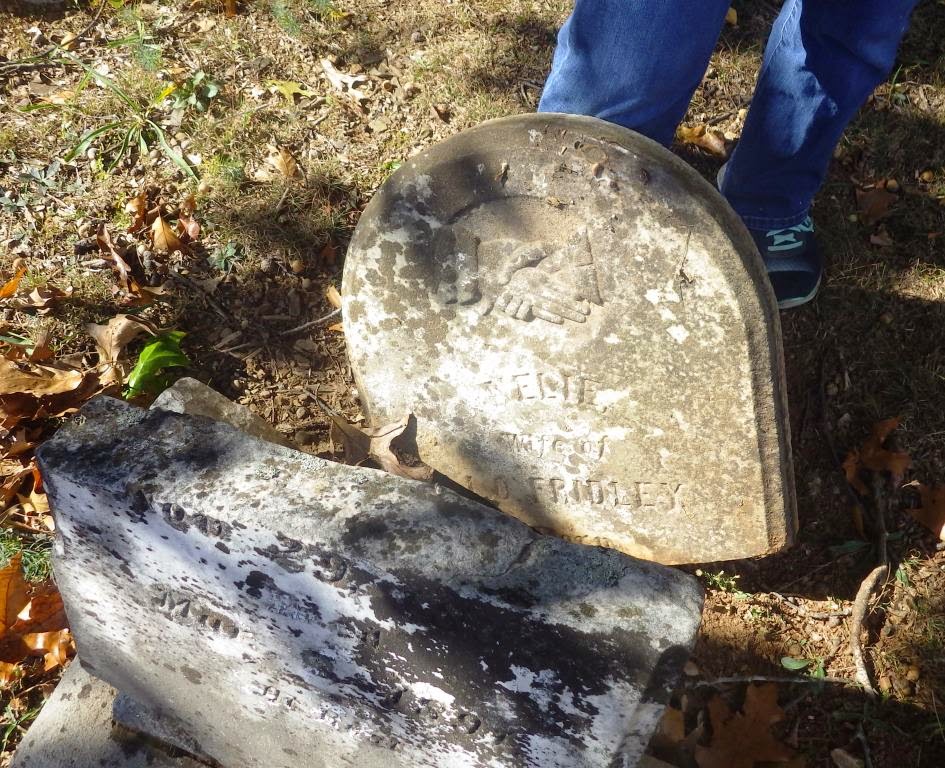
At the time, we didn't think much of it, and we didn't notice any Cornelias, or any Helmintollers or McKenneys we recognized. But Sherry double-checked that I photographed every stone, and called me back with the camera after I was ready to leave. She had found a headstone broken in half, and wanted a picture of it, so she supported the top half with her legs and I took the photo you see here.

Today, we were again reminded that Cornelia remarried after her first husband (Sherry's GG GF) died. She married a John O Fridley. And what this stone actually says is "Nelia, wife of J O Fridley". So not only did we find a picture of Sherry's Great-Great-Grandmother's tombstone, but it was a picture we took months ago without even realizing it.

Global Positioning

When Sherry and I decided to volunteer with Find-A-Grave to take pictures of gravestones, we felt that it was important that we have a record of the location where each picture was taken. Since digital cameras typically produce JPEG files, and the JPEG format can include header data with GPS location, we felt it was simplest to find a digital camera that included GPS that it would stamp onto each picture as it was taken.

It turns out this is called "GeoTagging" and is fairly common among a younger crowd. Younger than us, at least. At any rate, when we looked for GPS-enabled cameras last year, there were two kinds - GPS add-ons to expensive digital SLR cameras, and "tough" cameras. I found this whole new niche of digital cameras I didn't know existed - they are waterproof, shockproof, and geotag-ready. They even take pictures underwater!

So we got one, a Pentax model WG-3 GPS, which we've been very happy with. It takes a couple seconds from when you turn it on until it locates a GPS satellite and then every outdoor picture will be tagged. At home, I can examine the GPS tags and map where the grave location is on Google Maps.

Okay, now we know that GPS for cameras is probably only accurate to about ten feet. But even if the GPS gets you within 20 feet, it has really narrowed the area you have to search for a grave.

We leave the geotag information in the header when we upload the pictures to Find-A-Grave. On purpose.

Here's why.

I feel that the biggest next step for Find-A-Grave has to involve some kind of spatial proximity among graves. When we go to a cemetery to get genealogical information, one of the biggest ways to get information is to look at the graves around the one you already knew about. Maybe Uncle Joe is buried next to his parents. Or his children. Or the "significant other" he spent the last twenty years of his life with after his wife passed.

Find-A-Grave currently allows you to enter plot information. Sometimes this is useful, in larger, more organized, active cemeteries. For the smaller places Sherry and I frequent there isn't any plot information. Even in many of the larger cemeteries a plot number doesn't pinpoint the grave very well, unless you know all the intricacies of how to read the cemetery's cryptic markers.

Find-A-Grave also allows you to enter GPS coordinates for each memorial. This is done as an extra step. If it is a memorial you have created, you click "Add Plot" and enter the latitude and longitude from the photo, after extracting them and converting them to the right format. If the memorial was created by someone else, and you are just adding the photo, you have to send an edit request to the owner/creator of the memorial with the latitude and longitude. Probably if they notice that your name matches the photo, they will accept the edit without question. If they are still active in Find-A-Grave, of course.

Anyway, the point of the above rant is that it would be much simpler if Find-A-Grave decides to examine the GPS tags in the JPEG files themselves. They can automate the process of extracting the coordinates, converting them to the right format, and updating the location of the grave. And maybe by the time they get around to that, they will also address how to display grave positions so that their users can see what graves are nearby the grave of their loved one.

-- David, blogging from 39°08'40.4"N 77°24'45.0"W

Update, 17 Jan 2015

Find-A-Grave now has an "Upload and Transcribe" option in Beta form. You have to go to a link, http://www.findagrave.com/enable-beta, and then it shows a Transcriptions section on your member page, and on each cemetery page.

The idea is that you upload gravestone photos for a particular cemetery, and then you go in and transcribe the gravestone data directly into cemetery records. It's still Beta, so there's the occasional bug, but it seems very well done. You can enter one or more persons data for each stone, and if they already exist in the database it pulls up the existing entry. You have a week from when you upload the photos to transcribe them, and then they are released into a general pool where anyone can transcribe them.

As a side note - I've found that I still want to do a little pre-processing on the photos before I upload them. Usually I just crop the photo close to the stone, adjust the brightness/contrast, and compress.

All of that is fantastic on it's own, and a great improvement to the site. But in the spirit of this blog post, they actually pull the geotag data from the uploaded photos and attach it to the memorial records. Here's a link to one that we uploaded, and you can see the GPS info: Walter P Broyles

There's a Cemetery Photo Map link from the cemetery page, and that sounds very promising, but it doesn't seem to work yet. But as we know the GPS data is already in the system, so when they get it working it should be able to map the photos we are transcribing today.

Thank you, Find-a-Grave!

06 November 2014

Virginia Stones


Sherry wanted to research her family ties in the Alleghany County, Virginia area. She has a great-great-grandfather, John McKinney, that moved to the Rich Patch area south of Covington around 1840. He married Lucy, who was from that area, and they settled down and raised a family. About the time of the civil war, after the 1860 census, he disappeared. We haven't found a burial notice for him anywhere, so we thought we would go down in person to check a few possible spots.

So we packed up everyone in the car and headed to Virginia. The boys were intent on their video games and didn't seem to notice the drive much until we got to our first stop.

When we got to the first cemetery, the boys immediately found fields to play in and a hill to climb. So while we quickly surveyed and photographed the Johnson-Helmintoller-Plymale cemetery, the boys ran and played and had a great time. They weren't alone. When Sherry and I finished up, we went rock climbing as well.

The cemetery was well maintained and the majority of headstones were readable. We photographed the location.  The McKinney family was not against the headstones.  Our adventure continued to find the burial location of the McKinney family.


From here, we drove south, and found a church cemetery which we quickly surveyed.  We found multiple families at rest here. We took pictures and pushed forward.

Through the use of the Internet, we found another possible cemetery. We found a reference for a cemetery in Oriskany, which was in the next county over from Alleghany. It turned out to be a fabulous drive over the mountain and through the Jefferson National Forest, with many scenic views along the way.

The last part of the drive follows Craig Creek through fertile bottom land. We came into Oriskany and immediately found a cemetery right in the middle of town. We asked at the house if we were in the right place, and the owner pointed us to another cemetery down the road. We had to follow a farm road down to the swinging bridge, which sounded interesting.

We found that the road doesn't go over the bridge - it's for pedestrians only. The road crosses the creek at a shallow ford. We took it in stride, and the kids loved it. Upstream, we could see the swinging bridge, and we all eagerly anticipated exploring that adventure. But we saved that for the trip back.

The family cemetery gleamed beside an old cottage after the road crossed the ford. We dropped the boys off to run through farm fields and explore, and we checked out the what the boys referred to as the "boneyard." A quick overview revealed a family cemetery not established on the name McKinney. We consoled ourselves by mapping the 30 or so graves,.  Eventually I retrieved the boys from the cow pasture and literally dropped them in the creek.  Sherry stole off to the swinging bridge to check its safety. When the boys spotted her crossing the bridge it triggered a rush of adventure.

Sherry and the boys ran back and forth from the creek to the fields across the bridge and through the creek. The bridge was a great challenge - if you walked at more than a crawling pace, it lived up to it's name immediately.

The boys, Sherry and I, chatted excitedly about the day's activities of cliffs, swinging bridges, and creeks crossings. So much so, that the flinging of wet socks to be replaced by dry didn't elicit a "phew," or disgusted faces.

On the way home, we stopped at Pizza Hut for lunch, the boys gamed, while Sherry and I discussed the day's genealogical accomplishments.  In spite of finding little evidence of the McKinneys' final resting place (Sherry likes to point out, that we know now where they are not buried,) we had an awesome adventure!